
Bonds. We all have them. But why?
Last month, I asked you for topics you are interested in hearing more about, and I received some great responses. I picked this one since the subject matter has been making headlines nearly everyday (this email is dated 9/1/26 so keep that in mind if rates have shifted since then). Shoutout to my fabulous client for sending these great questions:
Bonds...I cannot for the life of me wrap my head around when yields go up, the price goes down. Or vice versa. I think it's the word "yield" that confuses me. but on a practical note, when I purchase bonds consistently and yields are going up, isn't the price (the number on my balance sheet) going down? Is there a way to get around this? And do I even care if the balance is going down if you hold a bond to maturity. but if you're buying an index bond fund, are you really holding a bond to maturity. So, how does that work?
I get that we need bonds to balance out our risk, but sometimes bonds do seem risky because they are dragging down the portfolio total balance. Making less than inflation. This makes me not want to go anywhere near them, especially since money markets are keeping up with and slightly beating inflation.
And...now that 30 year T-bills are paying 5.25%-ish, isn't that something we should buy?
So let’s break down how the value of bonds move when interest rates rise or fall, why we own bonds, and some things to keep in mind when you are looking at the fixed income holdings of your portfolio (by the way, “fixed income” is another term for bonds).
⚖️ The Seesaw: Yield vs. Underlying Value
The yield you receive on a bond and the actual price of the bond work in opposite directions.
Interest rates go up → the actual price of your bond goes down
Interest rates go down → the actual price of your bond goes up
Why is that? Think of yields and the underlying price of the bonds like this (numbers are hypothetical to illustrate the point): I am in the market to buy a bond. You have a bond that yields 3%, but pretend rates just increased to 4%. Your bond has to drop in price to give me an incentive to buy your bond with a lower yield. Why would anyone want your 3% bond when they can get one paying 4%? You still get your 3% yield, but the actual price of the bond is worth less because now I can get 4%.
On the flip side, if rates drop to 2%, the value of your 3% bond goes UP. Because now, everyone is going to want your 3% bond because it has a higher yield.
Following me? One of the biggest risks to bonds is interest rate risk. Interest rates do fluctuate. In my client’s example of 30-yr Treasuries paying 5.25%: what if rates go to 6%? 7%? You are locked in for 30 years at 5.25%, when you could be getting 6% or 7%. BUT, if rates drop to less than 5.25%, you may be wise to hold your 5.25% 30-yr bond!
The longer to maturity for your bonds, the more they are impacted by interest rate risk. Remember TLT in 2022? Ouch.
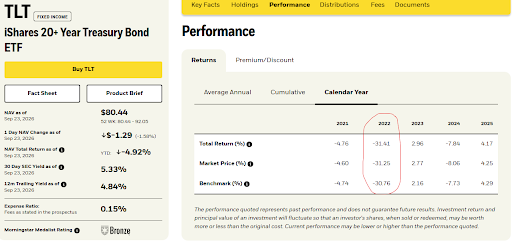
Long-term bonds are also heavily impacted by inflation risk. If inflation ever returned to what it was in the late 1970s, your 5.25% 30-yr bond is going to be pretty worthless at that point. It is why I rarely recommend long-term bonds. Stay in the short (1-5 yrs) and intermediate (5-10 yrs) term space so that you aren't locked into interest rate fluctuations for more than 10 or so years.
In a bond FUND, it works similarly in that the share price is going to decline because the underlying value of the bonds within the fund are declining. BUT, the yield on the bond fund is going to go up. So why do I recommend bond funds over individual bonds?
🏊♂️ Individual Bonds vs. Bond Mutual Funds
An individual bond is simply an IOU from a company or the government. You lend them money, they pay you interest, and on a specific maturity date, they give your money back. But managing a ladder of individual bonds yourself can be time-consuming and complicated.
This is why I primarily recommend bond mutual funds out of convenience and ease of use. Instead of holding a single IOU, a bond mutual fund owns thousands of IOUs. With a bond fund, you get:
Instant Diversification: You aren't relying on one single company to pay you back.
Low Maintenance: As older bonds in the pool mature, the fund managers automatically take that cash and buy brand new bonds. When interest rates rise, the fund naturally cycles into new, higher-yielding bonds. Bond fund managers rarely hold the bonds to maturity since funds are routinely needed to pay monthly interest payments and distributions to shareholders.
🛡️ Why We Hold Them
We need bonds in our portfolios for a variety of reasons: diversification, portfolio risk reduction, short-term cash needs, and income, just to name a few. Bonds can help us manage the overall risk of our portfolios. You have probably heard me say one of the basic principles of investing is: don’t take on more risk than you need to. If you can achieve a similar rate of return by taking on LESS risk, that’s the strategy that would make the most sense. Bonds are considerably less risky than stocks, so including them in your portfolio brings down the overall risk. BUT, I think clients often assume bonds are risk-free; they very much are NOT risk-free, as we are seeing now and as we saw in 2022. They can lose value but not nearly as much as stocks.
It stinks when an investment loses value, I get it. We have to accept that it IS going to happen to both stocks AND bonds. We got so used to interest rates being near 0% for so many years, and it took a global health crisis named Covid to start the interest rate hikes. If there is a silver lining in higher interest rates, it’s this: our cash is finally earning a respectable amount of interest (if you are still at a 0.1% interest rate for your savings account, we should talk. I’m seeing at least 3-3.5%.). Bond yields are up, and so are money market fund yields. But it also means inflation and mortgage rates are higher (hello, 7% 30-yr fixed) as well as other borrowing costs. When you zoom out, you’ll see that rates are still low compared to other periods throughout history. Stay invested, rebalance, stick to your reliable news sources, and remember: this, too, shall pass.
If you are interested in reading a great article written by Christine Benz of Morningstar on this very topic, this is a good one. I couldn't have said it better myself!
Quick Note: This content is purely for educational guidance and high-level strategy. It isn’t meant to be personal tax or investment advice. I always suggest checking in with a professional to confirm any moves make sense for your unique situation.
Talk soon,
Krystal